Independent Cable Testing
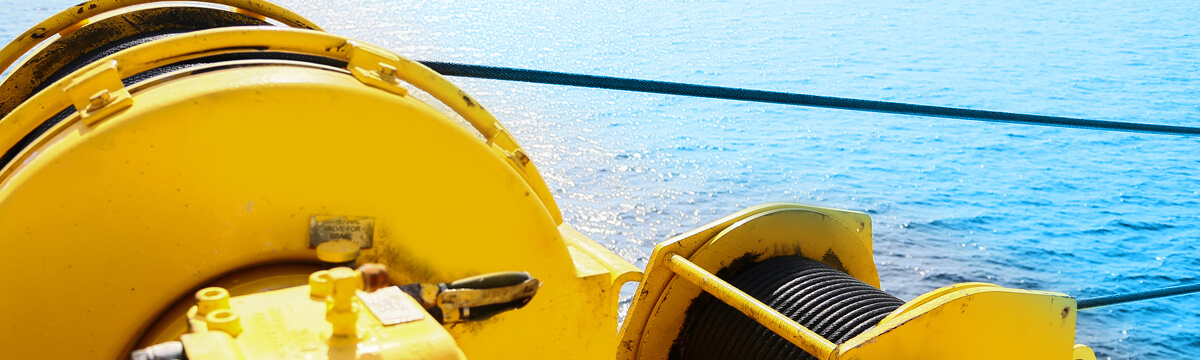
Ensure Survivability of Your Cable System at Sea
Typical at-sea conditions can cause catastrophic failures to your cable system. Our testing facility is fully equipped to simulate service conditions experienced by underwater cable systems and devices. Performing extensive laboratory testing can help you identify potential problems prior to use.
Cable Testing FAQs
Yes, PMI can perform a wide range of in-house cable tests, including tension, cyclic tension, servo-controlled tension, long-span tension setup, hydrostatic pressure, cyclic bend over sheave, cyclic tension over sheave, cyclic flexure, reverse bend over sheave, torque and rotation, induced torque/rotation, as well as electrical and optical testing.
Tension: Break strength, proof load certification, load vs. elongation, fatigue and retirement criteria, dynamic load simulation, cable qualification and pre-tensioning.
Measurement and Analysis: Tension vs. torque or rotation, torque-balance verification, non-rotating and twist resistance testing, torque-restraint validation, conductor and optical fiber performance monitoring.
Bending: Static and dynamic bending, handling system simulation, fairing and hardware qualification, wet/dry fatigue performance, jacket abrasion, and tow point dynamics.
Hydrostatic Pressure: At-depth pressure simulation with verification of seal, and electrical and optical performance.
PMI can test raw or terminated cables, unterminated cables, and complete cable assemblies, etc. We handle cables with steel or synthetic strength members, as well as those without any strength member.
PMI most commonly tests cables used in underwater applications, but our capabilities are not limited to these environments. We are happy to review and discuss any cable to determine appropriate testing options.
The required cable length will depend on the type of test being performed.
A drawing or sample of the cable is most helpful, allowing us to review the cable construction and determine the best testing approach.
Yes. To help us provide an accurate quote, please provide any available details, such as strength member type, core construction, outer jacket material, outer armor, outside diameter, rated break strength, rated working load, and any other specifications.
PMI customizes each test to the needs of your project. Understanding how the cable will be deployed and used helps us develop an effective test plan. We can create a plan with you or review any existing plans you have, using our standard process as a foundation.
Key factors include the type of testing, number of cycles, duration or hold times, measurement (electric, optic, voltage level, frequency, wavelength, etc.), whether measurements are taken during or before/after testing, and applicable specifications. PMI will review all details to ensure feasibility.
Yes, PMI conducts qualification testing and acceptance testing on previously qualified designs.
Yes, PMI can terminate the cable and install connectors before testing.
Yes. After reviewing, PMI can often use customer-provided test leads and equipment, such as mate connectors, special hardware adaptors, pressure caps, etc.
The lead time will depend on the type of test, complexity, quantity, requirements, and any equipment modifications needed.
Please send all inquiries to sales@pmiind.com.
PMI’s specialty is to provide insight into the interaction between the strength member and attached hardware or the complete cable assembly. We will test all or any part of your project:
- Raw Cable (Metallic and Synthetic Strength Members)
- Rope and Hose Assemblies
- Cable Assemblies
- Cable Hardware
- Terminations
- and More
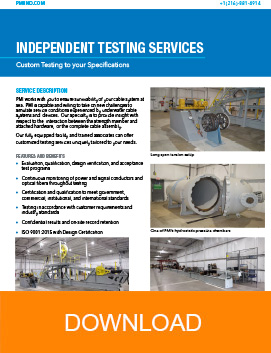
Testing services can be uniquely tailored to meet your needs:
- Evaluation, qualification, design verification, and acceptance test programs
- Continuous monitoring of power and signal conductors and optical fibers throughout testing
- Certification and qualification to meet government, commercial, institutional and international standards
- Standardized test methods and test report format IAW ANSI Z39.18
- Confidential results and on-site record retention
Tension
- Break Strength
- Test Load vs. Elongation Data
- Proof Load Certification
- Dynamic Load Simulation
- Fatigue and Retirement Criteria
- Cable Design Verification/Qualification
- Certification of Cable Assemblies
- Pretensioning of cable prior to terminating
Hydrostatic Pressure
- Simulate At-Depth Pressure Loading
- Verify Seal and Electrical and Optical Performance
Bending
- Static and Dynamic Cable Qualification
- Simulate Handling System Problems
- Qualify Cable Fairing and Hardware
- Verify Wet/Dry Fatigue Performance
- Cable Jacket Abrasion Tests
- Simulate Tow Point Dynamics
- Fatigue Testing
- Design Qualification
Measurement and Analysis
- Tension vs. Torque
- Tension vs. Rotation
- Torque Balance verification
- Cable Qualification
- Verify “Non-Rotating”
- Test for Twist Resistance
- Torque Restraint Testing Verification
- Monitoring & Measurement of Conductor and/or Optical Fiber Performance
If you’re interested in PMI’s testing facility and services, schedule a free consultation to learn more.